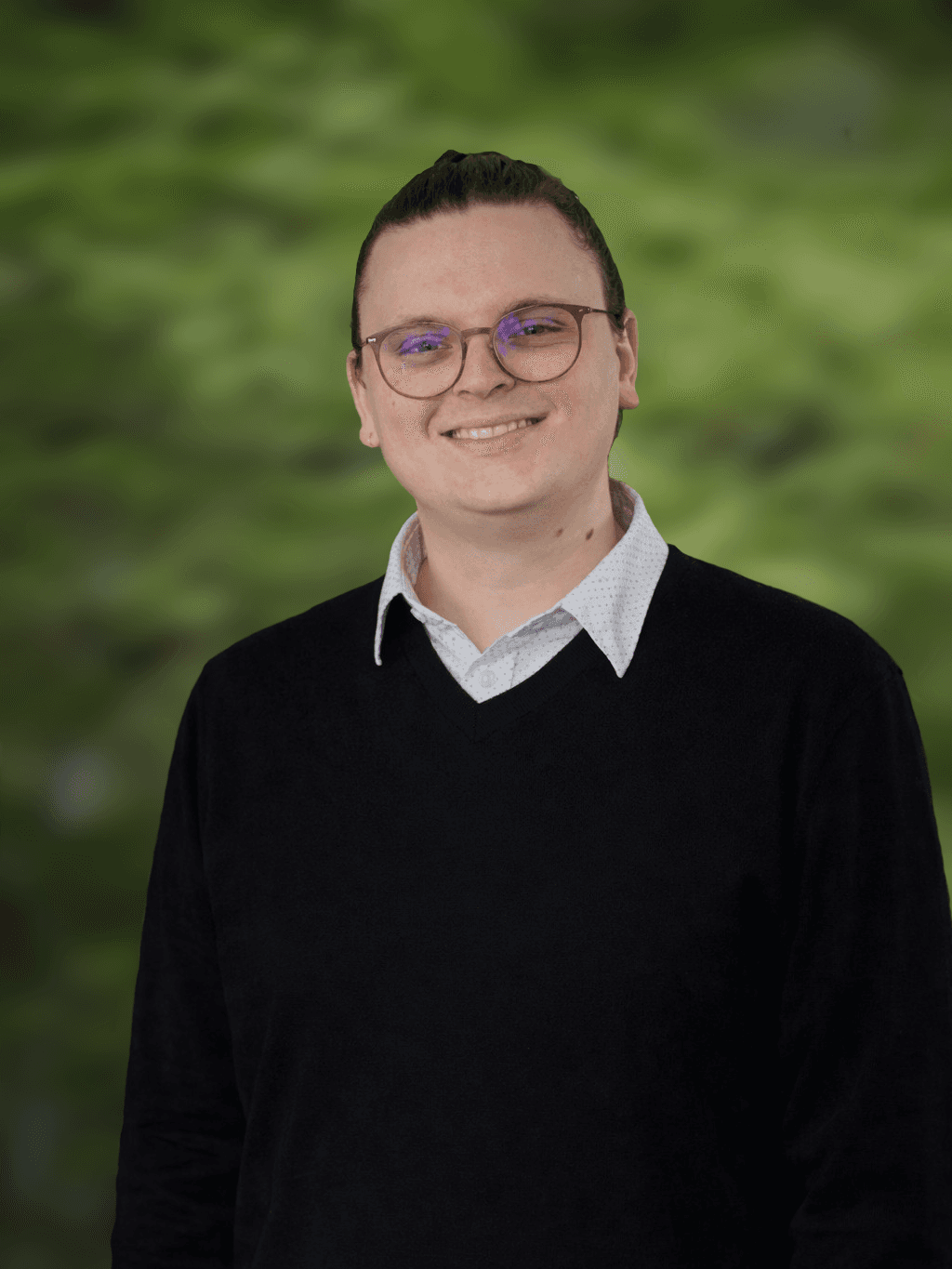
I studied Computer Science at the FH Aachen University of Applied Sciences in Germany and wrote my thesis about Large Language Models. After graduating, I moved to Belgium and started working in IT at the International German School of Brussels. Over time and alongside my work, I continued to deepen my knowledge in web development. I invite you to explore my portfolio.
My most recent project is this personal website you are looking at right now. I built it to present my skills, projects, and experiences, using Next.js and React.
It includes a chatbot to answer questions about me, and help users navigate the website. For this, I implemented function calling, so the chatbot can interact with the website. The chatbot uses Google's Gemini API, but could also be adapted to work with other APIs.
I implemented a contact form that sends email notifications via SMTP2GO, following common security best practices (e.g. header sanitization). To prevent spam, I use server-side rate limiting with Redis.
Feel free to play around with the chatbot and explore my website! You can also find the code on GitHub using the link above.
Education
Multimedia Communication and Documentation Bachelor's program
TH Aschaffenburg University of Applied Sciences
Aschaffenburg, Germany
2018 - 2020
Graphic Design
User Oriented Design
Web Design
CSS
HTML
JavaScript
Adobe Creative Suite
I began my studies with a Bachelor's program in Multimedia Communication and Documentation at the TH Aschaffenburg University of Applied Sciences. The program focused on user-oriented design and communication.
While studying in Aschaffenburg, I worked with many different multimedia tools, including the Adobe Creative Suite and first experience with web design and technologies like HTML, CSS and JavaScript. I developed an eye for usability, clarity and the need to meet users where they are.
I realized that, while the focus on user experience and design was very interesting to me, I started reaching the limits of how I could apply this knowledge in practice and was more and more interested in the technical side of things. I spent more time learning programming on the side, and eventually decided to switch to a Computer Science degree to build a stronger technical knowledge. The skills I acquired still influence how I approach software development today.
Work Experience
IT Support & Software Development
International German School of Brussels (iDSB)
Wezembeek-Oppem, Belgium
2025 - Present
I started working at the International German School of Brussels in February 2025, initially doing IT support only. My responsibility is to provide support to over 700 users, including staff, students and parents, for any kind of IT-related issues. This includes managing user accounts, setting up new devices and other system administration tasks, as well as troubleshooting hardware and software issues and coordinating external repairs when necessary.
Over time, my role increasingly developed towards software development. Today, I spend the majority of my time building internal applications and tools that help digitize documents and processes within the school.
My main development project is an internal system built with React and Next.js. It includes Microsoft 365 authentication, email notifications, and workflow and approval tracking. I design and iterate on this application based on user feedback, with the goal of making internal processes easier and more transparent for the people using them.
In addition to this larger project, I build smaller internal tools with React to improve day-to-day workflows.
Coding and Problem-Solving Specialist for AI Training
Outlier
Remote
2024
In 2024 I worked on the Outlier platform as a Coding and Problem-Solving Specialist, contributing to the training and evaluation of large language models.
I mainly focused on solving complex coding and reasoning tasks, designed to identify weaknesses of current AI models. These tasks required me to carefully analyze the problem and come up with a solution that correctly handled all kinds of edge cases.
Additionally, I reviewed and improved solutions created by others, and wrote new coding tasks that were designed to be challenging for AI models.
For most tasks, I worked with Python to create solutions, which I documented in detail, so they could be easily reviewed by others.
My contributions were used to improve the performance of large language models on coding and reasoning tasks.
Working Student - Web Design
VacuuBrand
Wertheim, Germany
2019
Web Design
UI Design
CSS
HTML
In 2019, while studying Multimedia Communication and Documentation, I worked at VacuuBrand as a working student.
My task was to design and implement a landing page for Vacuu-LAN. I implemented it within VacuuBrand's CMS using HTML and CSS, applying my knowledge in web design. The landing page works on both mobile and desktop devices.
Languages
German
Native Speaker
I was born and grew up in a small town in southern Germany, so German is my native language. It was the main language throughout my education.
Today, it is also one of the two main languages I use at work.
English
C1 Level (Advanced)
I started learning English in primary school. In high school, English was one of the subjects I chose for advanced courses.
During my university studies, I had several courses taught in English and participated in group projects with international students. My thesis was also written in English.
Today, English is one of the two main languages I use at work to communicate with colleagues.
French
B1 Level (Intermediate)
Ever since I knew that I would eventually move to Brussels because my partner already lived here, I started learning French.
I began with Duolingo, where I currently proudly hold a streak of over 1500 days - follow me on Duolingo if you want to :). Since moving to Brussels, I'm also taking French classes.
I keep making progress every day and am proud of every everyday conversation that works a little better than the last one.
With SimplePolls, I wanted to create a simple and user-friendly application that showcases my ability to build full-stack web applications. The application has a React frontend and an Express backend.
For the backend I decided to create a public RESTful API. The API is documented using OpenAPI (Swagger UI) and can be accessed publicly. I used Prisma as an ORM to interact with a PostgreSQL database. I implemented various security features such as rate limiting and authentication for modifying data, and made a conscious decision on how to set up CORS. To make sure that everything works as expected, I wrote tests for the API using Supertest and Vitest.
For the frontend I wanted to create a fun and intuitive interface. It is built with React and uses React Router in Data Mode for routing. The design is responsive, allowing users to enjoy the application on both mobile and desktop devices. Users can create, edit, share and participate in polls. Also, I implemented internationalization using i18next, making the frontend available in English, German and French.
Please use the links above to check out the project and its code!
Because I love learning about different countries and their flags, I created GuessTheFlag to test and improve my flag knowledge in a fun way, and also practice my React skills.
You are shown a random flag and you have to guess the country name as quickly as possible, collecting points for correct answers and speed, while competing against your own high score.
Because I use the REST Countries API to get the country names, the user can guess the country names in 26 different languages. For the flags themselves, I use the Flags API & CDN by Flagpedia.net. This way, I can be sure that the country names and flags are always up to date.
B.Sc. Computer Science
FH Aachen University of Applied Sciences
Aachen, Germany
2020 - 2024
Machine Learning
Model-Based Systems Engineering
Object-Oriented Programming
Software Engineering
Web Development
C++
Java
JavaScript
PHP
Python
SQL
Angular
Laravel
Vue.js
Grade: 1.3 (ECTS: A), graduated with distinction (top 5% of graduates)
Thesis: Prototype Implementation for Retrieval Augmented Generation and Evaluation of Major LLMs
I studied Computer Science at the FH Aachen University of Applied Sciences from 2020 to 2024. The program covered different aspects of computer science:
I had courses in higher mathematics, algorithms, data structures and computer architecture, which helped me build an understanding of the theoretical foundations of computer science.
I also became confident in multiple programming languages, including object-oriented programming with Java, C++ and Python. Web development remained a very important topic to me, as I deepened my knowledge in frontend and backend development using the languages PHP, JavaScript/TypeScript, and SQL, together with frameworks like Laravel, Vue.js and Angular.
I enjoyed learning core software engineering skills, like UML, design patterns, testing and project management.
For my thesis with the title "Prototype Implementation for Retrieval Augmented Generation and Evaluation of Major LLMs", building on previous courses in artificial intelligence, I implemented a prototype for Retrieval Augmented Generation (RAG). RAG is a technique to enhance the capabilities of large language models (LLMs) by integrating external knowledge sources. Using this prototype, I evaluated multiple LLMs to determine their performance in RAG, by feeding them with the content of the German-language Wikipedia, and asking questions on the provided text. The evaluated models included versions of OpenAI's GPT models via the OpenAI API, as well as versions of locally executed models like Llama, Gemma, Mistral, and Mixtral. The thesis was part of the AKzentE4.0 project of FH Aachen, which aims to make AI technologies accessible for small and medium-sized enterprises.
My thesis was graded with 1.0, the best possible grade. Overall I graduated with a grade of 1.3 and distinction, being among the top 5% of graduates in my program.